
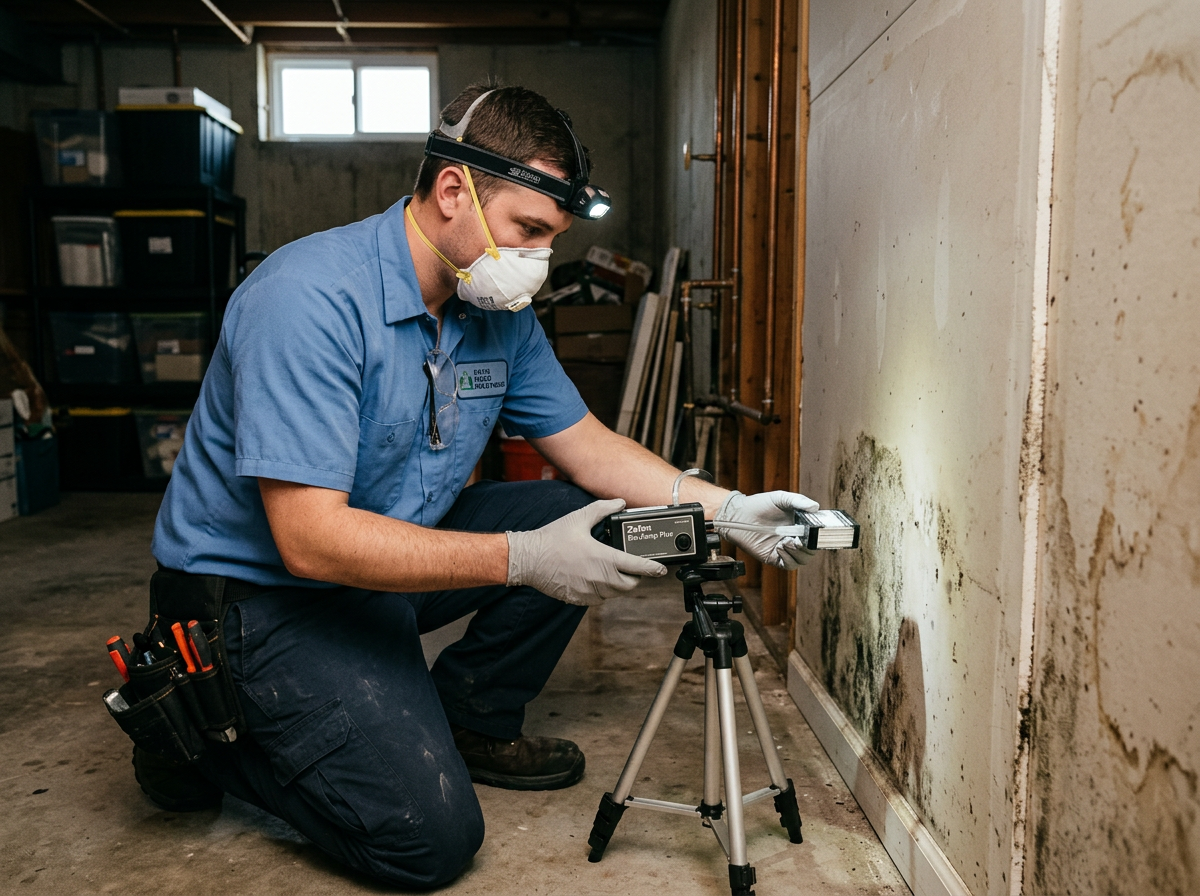
Cedar Valley features a blend of established rural homes and newer large builds on the high water table west of Utah Lake. Work in this Utah Valley location depends on UT-68 access from Springville and attention to seasonal temperature swings.
Cold winters and hot summers influence when moisture problems appear in local housing stock, requiring crews to address drainage and ventilation specific to the valley floor setting.
Here's how our mold inspection and testing work runs in Cedar Valley — the same standards we hold across Utah, delivered by the crew that covers Utah County.
Mold Inspection and Testing Services We Offer in Cedar Valley
✓Visual and Moisture-Meter Inspection
Systematic walkthrough using moisture meters on walls, floors, and ceilings to locate active and past leaks common in Utah slab-on-grade basements.
✓Air Sampling
Spore trap or culture sampling performed only when visible growth is absent or when third-party documentation is required for property transfers.
✓Pre-Purchase Inspection
Focused assessment of homes under contract, checking finished basements, crawl spaces, and areas near swamp coolers for hidden moisture issues before closing.
✓Post-Remediation Verification
Follow-up inspection and moisture readings after source repair and material removal to confirm the affected areas have returned to dry baseline conditions.
✓Humidity and Condensation Assessment
Evaluation of winter humidifier settings and tight-building envelopes that cause moisture to collect on exterior walls during inversion events.
In Utah homes, mold almost always traces back to a specific mechanical failure rather than general humidity. A leaking supply line behind a finished basement wall, an undrained swamp cooler left over winter, or condensation on north-facing walls during inversion can create hidden growth that stays undetected for months. Our inspection starts with a thorough visual survey and moisture-meter readings on drywall, baseboards, and subflooring to map the actual extent of affected material.
Air sampling is used only when growth is not visible or when documentation is needed for a real-estate transaction. When visible mold is present, we document location, size, and substrate condition instead of defaulting to lab tests. We also check crawl spaces in Wasatch Back properties and unheated garages where frozen pipes commonly burst once temperatures rise.
How It Works in Cedar Valley
- 1
Initial Walkthrough
We examine every room, paying special attention to finished basements on slab, north walls, and areas near appliances or plumbing runs.
- 2
Moisture Mapping
Meter readings are taken at regular intervals on drywall, baseboards, and subfloor to define the full footprint of elevated moisture.
- 3
Source Identification
We trace elevated readings back to the mechanical failure—supply line, roof penetration, or undrained swamp cooler—and document the exact location.
- 4
Report and Recommendations
A written summary lists findings, required openings, and the sequence of repairs needed before any removal work can succeed.
Serving All of Cedar Valley
We regularly handle mold inspection and testing jobs near:
- 📍UT-68
- 📍areas west of Utah Lake
- 📍rural valley roads
Mold Inspection and Testing Pricing in Cedar Valley
Scope depends on square footage inspected, number of samples if any, and property access conditions. Call for a site-specific quote.
Want the full picture of this service? See our Mold Inspection and Testing page, or everything we do in Cedar Valley, UT.