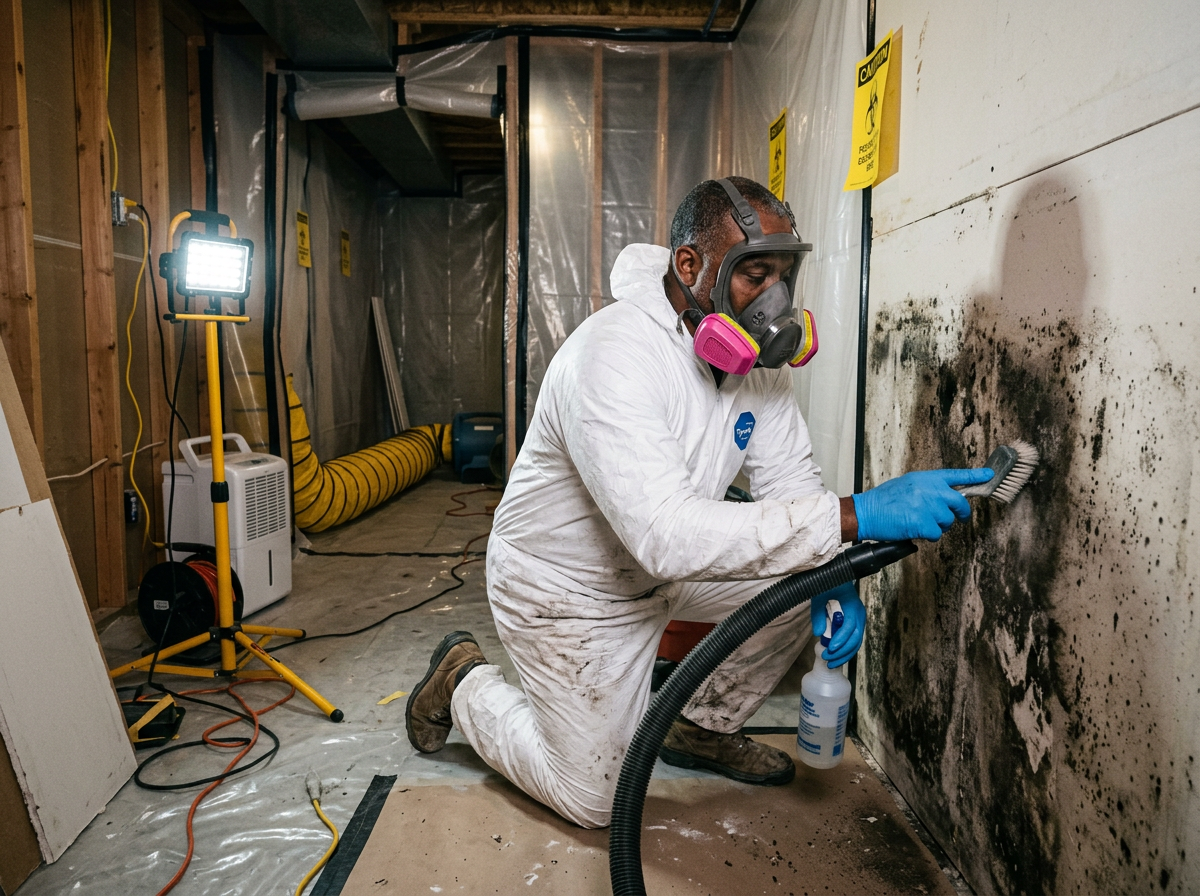
Black mold in Utah structures almost always traces back to a mechanical water event rather than general humidity. A burst supply line behind a finished basement wall, a swamp cooler left undrained through winter, or an ice dam on a north-facing roof can feed hidden growth for months before discoloration appears on drywall or baseboards. Finished basements poured directly on slab hide slow leaks under carpet or laminate, allowing mold to colonize framing and subfloor while the living space above stays dry to the touch.
Removal begins with locating and stopping the water source, followed by establishing containment and negative air to keep spores from migrating into clean areas. Affected drywall, insulation, and base trim are cut out beyond visible growth, bagged on site, and removed. Remaining surfaces receive HEPA vacuuming and damp wiping; antimicrobial agents are applied only after all porous material has been addressed. Post-remediation verification uses moisture meters and visual inspection to confirm the structure is dry before any rebuilding.
Jobs fail when the leak is left active or when only surface cleaning occurs. In tight modern homes along the Wasatch Front, winter inversion layers push condensation into north-facing closets and exterior walls, restarting growth within weeks if the envelope issue is ignored. Springville properties with crawl spaces under unheated garages frequently see frozen lines thaw and leak undetected until mold reaches living areas above.
Technician insight
In Springville, the thing that catches most people out with Black Mold Removal is finished basements on slab. A slow supply-line leak can run under the concrete for six months before any wall discoloration shows, so we always pull baseboards and check the slab edge even when the homeowner thinks the problem is limited to one closet.
Hidden Slab Leak in Springville Basement
A homeowner noticed dark staining along one basement wall after a cold snap. Inspection revealed a failed ice-maker line behind the finished wall that had leaked onto the slab for months. We established containment, removed the lower four feet of drywall and insulation, extracted the wet subfloor section, and coordinated line replacement. The space passed moisture verification and was cleared for rebuild.
Black Mold Removal Services We Offer
✓Containment and Negative Air
Physical barriers and negative-air machines isolate the work zone so spores do not spread into unaffected rooms during removal.
✓Affected Material Removal
Drywall, insulation, baseboards, and other porous materials extending past visible growth are cut out and bagged for disposal.
✓HEPA Cleaning and Vacuuming
All remaining hard surfaces receive HEPA-filtered vacuuming and damp wiping to capture residual spores after material removal.
✓Source Identification and Repair Coordination
Technicians locate the leak or moisture entry point and coordinate with plumbers or roofers to correct it before remediation finishes.
✓Post-Remediation Verification
Moisture meters and visual checks confirm the area is dry and free of remaining growth before any reconstruction begins.
How it works
- 1
Source Location
Inspect plumbing, appliances, roof, and grading to identify the water entry point driving the growth.
- 2
Containment Setup
Install plastic barriers and negative-air machines to keep the work area isolated from the rest of the home.
- 3
Material Removal
Cut out and dispose of affected drywall, insulation, and trim beyond the visible mold line.
- 4
HEPA Cleaning
Vacuum and wipe all remaining surfaces with HEPA equipment to remove airborne and settled spores.
- 5
Verification
Use moisture meters and visual inspection to confirm the structure is dry before release.
Pricing
Scope and cost are determined after an on-site inspection that identifies the extent of affected materials and the required source correction. Call to schedule an assessment.